Category: AI – LLMs

  • SEO VPS vs SEO Dedicated Server: Which Multiple-IP Setup Do You Actually Need?

    SEO VPS vs SEO Dedicated Server: Which Multiple-IP Setup Do You Actually Need?

    TL;DR

    Comparing SEO VPS vs Dedicated Server? Both the ASEOHosting SEO VPS and Dedicated Server draw from the same 800+ Class C IP pool at the same IP Manager Tool. The choice is not about IP access — it is about the server resource model beneath your IP network. The SEO VPS (from $40/mo) is the right call for networks under 150 active domains with moderate crawl workloads. The Dedicated Server (from $199/mo) is justified when concurrent crawl activity, 150+ WHM accounts, and bare-metal performance isolation become operational requirements. The IP cost-per-domain math favors the VPS at mid-scale (50–150 IPs at $3.75/IP) and the Dedicated at large-scale operations where resource adequacy outweighs the per-IP rate difference.

    Choosing between an SEO VPS vs dedicated server comes down to one variable most comparison guides never surface: not which tier gives you Class C IP access — both do, from the same 800+ IP pool — but how much raw server resource sits beneath that IP network. Both products include multiple Class C IPs, root access, and the IP Manager Tool to reassign addresses with a single click. The actual decision is about what manages those IPs: a KVM-allocated virtual slice on shared hardware, or full ownership of a bare-metal machine with no hypervisor overhead and no competing tenants.

    Audio version of the SEO VPS vs Dedicated Server guide. Hosted by Daniel Page, Director of Business Development, ASEOHosting. Full post: https://www.aseohosting.com/blog/2026/06/seo-vps-vs-dedicated-server-multiple-ip/

    What Actually Separates an SEO VPS from an SEO Dedicated Server

    Furthermore, the distinction between these two tiers runs deeper than the price tag. The infrastructure model underneath your IP network determines how your server handles concurrent requests, WHM overhead, and crawler load — and that model is fundamentally different between the two products.

    KVM Virtualization vs. Bare Metal — What It Means for a Multi-Site IP Network

    An ASEOHosting SEO VPS runs on KVM-based virtualization — your plan receives a guaranteed allocation of RAM (1 GB to 8 GB), CPU cores (1 to 6), and SSD storage (75 GB to 250 GB), isolated from other VPS instances on the same physical host. That isolation is real and enforced by the hypervisor. However, the underlying physical machine is shared, which means CPU time is scheduled across VPS instances by the hypervisor even when your core allocation is protected.

    A Dedicated Server eliminates that layer entirely. When you lease an ASEOHosting dedicated machine — starting from the 4-core Intel Xeon E3-1231 v3 at $199/mo — every CPU cycle, every GB of RAM, and every I/O operation belongs exclusively to your account. There is no hypervisor scheduling your processes alongside anyone else’s. For multi-site Class C IP networks, this distinction surfaces under load: when WHM is managing hundreds of cPanel accounts, when link-monitoring scripts run across dozens of outbound IPs simultaneously, and when WordPress installs are serving live search traffic concurrently.

    The 800+ Class C IP Pool Is Identical on Both — Here’s What Isn’t

    The IP layer is genuinely equivalent across both tiers. As explained in our detailed guide to what SEO hosting actually is, ASEOHosting maintains a pool of over 800 distinct Class C subnets, with each IP assigned exclusively — no address is shared between accounts. Whether you are on a $40/mo VPS or a $1,099/mo dual-Xeon dedicated machine, you pull from that same pool. The IP Manager Tool assigns or reassigns any Class C IP to any domain in your account in a single click, without a support ticket, on both tiers.

    Consequently, what differs is what manages those IPs: a KVM-allocated virtual slice with 1–8 GB RAM, or a bare-metal machine with 16–64 GB RAM and no hypervisor overhead. The IP pipeline is identical. The server that processes inbound Googlebot requests and outbound link-monitoring traffic is not. That server model is what this decision actually turns on.

    YouTube Video

    How Many Class C IPs Do You Actually Need? (The Question Competitors Skip When Comparing SEO VPS vs Dedicated Server)

    In practice, most buyers anchor this decision on IP count rather than workload. That framing misses the real constraint. The correct question is: how much server resource does your IP network demand at your target operating scale? Here is a scale-based breakdown drawn from the ASEOHosting plan specifications.

    Small Networks Under 75 Domains: VPS Has Plenty of Headroom

    For a domain network under 75 sites, the SEO VPS handles the workload without resource contention. The VPS-2 tier ($60/mo, 2 GB RAM, 2 cores) or VPS-3 ($90/mo, 4 GB RAM, 4 cores) manages 75 cPanel accounts under WHM with typical publishing loads — a WordPress install serving organic traffic and a standard content update schedule is a predictable, moderate workload that sits well within the VPS-3 resource envelope.

    Additionally, the IP add-on cost at this scale is favorable: once you cross 50 IPs, the VPS rate drops to $3.75 per IP — the lowest per-IP rate in the entire ASEOHosting catalog. A 60-IP VPS network at the mid-volume tier runs approximately $225 in IP add-ons, making a full multi-IP setup achievable under $330/mo including cPanel. The 30-day money-back guarantee on SEO VPS plans also reduces entry risk while you validate your workload assumptions.

    Mid-Scale Networks of 75–200 Domains: The Resource Crossover Zone

    Between 75 and 200 active domains, resource planning becomes non-trivial. WHM managing 150 cPanel accounts tracks DNS zones, MySQL databases, and email configurations for each — a memory footprint that runs approximately 3–5 GB for the process stack alone before a single WordPress install serves a request. Add cron jobs, monitoring scripts, and nightly backups, and the VPS-3 at 4 GB RAM reaches its practical ceiling around 100 accounts.

    The VPS-4 tier ($135/mo, 8 GB RAM, 6 cores) extends that ceiling meaningfully. At 150 domains, this plan is the correct VPS choice. However, it is worth running the total cost math here: VPS-4 at $135/mo plus 100 IPs at $3.75 each ($375) plus cPanel ($15) equals $525/mo total. The entry dedicated server at $199/mo plus the same 100 IPs at $4.75 each ($475) plus cPanel ($45) equals $719/mo. The VPS wins on total cost at the 100-IP scale — but you are operating near its resource ceiling, which has implications for concurrent crawl workloads.

    Large Operations Above 200 Domains: Why Bare Metal Wins on Crawl Concurrency

    Above 200 active domains, the server resource model determines outcomes more than IP pricing does. Managing 200 cPanel accounts in WHM, serving live WordPress traffic across all domains, running automated link-verification crawlers across 200 outbound Class C IPs, and processing rank-tracking or monitoring scripts simultaneously exceeds the practical envelope of 8 GB RAM and 6 vCPU cores — even with an efficient server stack.

    The entry-level ASEOHosting dedicated SEO server (Intel Xeon E3-1231 v3, 4 cores at 3.4 GHz, 16 GB RAM) doubles the RAM ceiling immediately. Moreover, for crawl-intensive operations, the 3.4 GHz physical clock speed of the Xeon E3 matters: as Google’s crawler infrastructure documentation illustrates, outbound link-check scripts and per-domain monitoring processes often run as single-threaded operations, making per-core clock speed more directly useful than aggregate vCPU count on a shared KVM host.

    SEO VPS vs Dedicated Server: The Honest Head-to-Head That Tells the Truth

    Specifically, the following table covers every specification dimension a multiple-IP buyer should evaluate before choosing a tier. All figures are drawn directly from ASEOHosting’s verified live product pages. This is the ASEOHosting SEO VPS vs Dedicated Server — Key Specifications and IP Economics table, structured as a standalone reference.

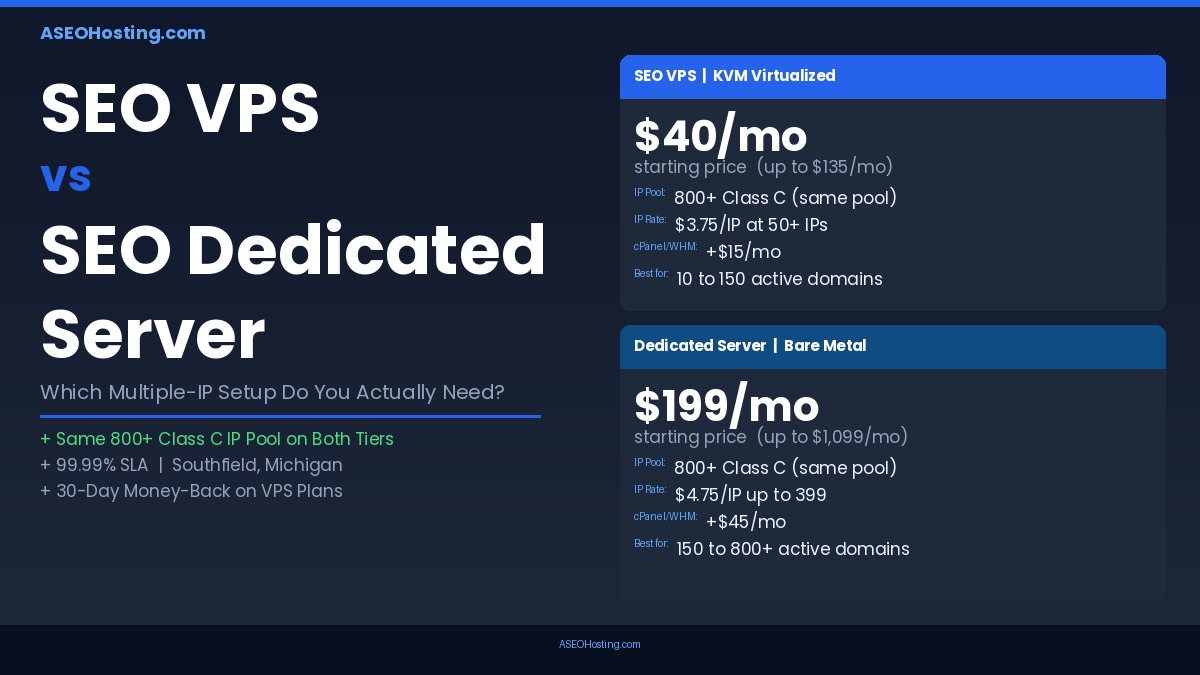
    FeatureSEO VPS (ASEOHosting)SEO Dedicated Server (ASEOHosting)
    Starting price$40/mo$199/mo
    Top plan price$135/mo$1,099/mo
    Hardware modelKVM virtualized — shared physical hostBare-metal — exclusive physical machine
    Entry-level RAM1 GB → up to 8 GB16 GB → up to 64 GB
    Entry-level CPU1 core → 6 cores (vCPU)4 physical cores @ 3.4 GHz → 16 cores @ 2.4 GHz
    IP pool access800+ Class C IPs (same pool)800+ Class C IPs (same pool)
    IP add-on pricing$4.75 (5–49) → $3.75 (50–799) → $3.25 (800–1,000)$4.75 (5–399) → $4.25 (400–800)
    cPanel/WHM cost+$15/mo+$45/mo
    Optimal domain scale10–150 active domains100–800+ active domains
    Crawl concurrencyModerate — KVM scheduling overhead under heavy loadHigh — no hypervisor layer, direct hardware access
    Uptime SLA99.99% network uptime99.99% network uptime
    Free migrationNot statedFree from any cPanel host
    Money-back guarantee30-dayNot stated
    Datacenter locationSouthfield, Michigan, USASouthfield, Michigan, USA (same facility)
    ASEOHosting SEO VPS vs Dedicated Server — At a Glance Side-by-side specification comparison: SEO VPS from $40/mo on KVM virtualization, Dedicated Server from $199/mo on bare metal, both accessing the same 800+ Class C IP pool. 800+ Class C IPs — Same Pool on Both Tiers SEO VPS — KVM Virtualized Starting price$40/mo Top plan (8 GB RAM / 6 cores)$135/mo Best IP rate (50-799 IPs)$3.75/IP cPanel/WHM add-on+$15/mo Hardware isolationKVM hypervisor Ideal domain scale10 to 150 domains Uptime SLA99.99% Best for moderate to mid-scale crawl workloads Dedicated Server — Bare Metal Starting price$199/mo Top plan (16 cores / 64 GB RAM)$1,099/mo IP rate (5-399 IPs)$4.75/IP cPanel/WHM add-on+$45/mo Hardware isolationExclusive physical machine Ideal domain scale150 to 800+ domains Uptime SLA99.99% Best for large-scale concurrent crawl operations ASEOHosting.com — Figures verified from live product pages, June 2026

    When an SEO VPS Is the Right Multiple-IP Setup for You

    Directly: choose the SEO VPS when your domain count is below 150, your crawl workload is scheduled rather than simultaneous, and the $3.75/IP mid-tier pricing gives you the best per-IP cost in the ASEOHosting catalog. Additionally, the VPS tier makes sense when your operation is still in a build-and-scale phase — where flexibility and a lower monthly commitment matter more than bare-metal performance headroom.

    Specifically, the ASEOHosting SEO VPS delivers best value when:

    • Your PBN or niche site network runs 10 to 100 domains with regular content updates and link acquisition
    • Your agency manages up to 75–100 client accounts requiring IP isolation — but crawlers run overnight, not around the clock
    • Your crawl workload is scheduled: link-verification scripts run at off-peak hours rather than in parallel across all domains simultaneously
    • You want full root access and cPanel/WHM without committing to dedicated server pricing and cPanel fees
    • You need the 30-day money-back window to validate your workload before a long-term infrastructure commitment
    • Your IP count is in the 50–150 range, where VPS add-on pricing at $3.75/IP beats the dedicated server rate

    Moreover, for agencies that also manage smaller client sites needing basic shared IP hosting, the ASEOHosting shared SEO hosting plans handle entry-level accounts, freeing the VPS for the clients that specifically need dedicated Class C IP addresses.

    When an SEO Dedicated Server Is the Only Logical Answer

    By contrast, the Dedicated Server becomes the logical choice when server resource limits — not IP count or per-IP price — drive the decision. Notably, this is the point most guides miss: the dedicated server is not a premium version of the VPS for buyers who want more IPs. It is a fundamentally different infrastructure tier for operations where concurrent resource demand exceeds what KVM-allocated resources can sustain.

    Specifically, escalate to the ASEOHosting dedicated SEO server when:

    • Your active domain count exceeds 150 and automated crawlers run daily across the full domain set
    • WHM is managing 100+ cPanel accounts with real traffic on each — not just parked domains
    • You require bare-metal performance isolation for client SLAs where predictable response times matter
    • Link-building or PBN operations depend on simultaneous outbound crawler activity across 150+ unique Class C IPs during peak hours
    • Custom kernel configurations, server-level firewall rules, or specialized SEO tooling require direct hardware access
    • The Michigan datacenter’s Intel Xeon hardware specs and Detroit Internet Exchange connectivity (450 Gbps peak, 50+ member networks) are relevant to your crawl latency requirements

    In practice, the entry ASEOHosting dedicated plan at $199/mo delivers 16 GB RAM and 4 physical cores at 3.4 GHz — compared to the VPS-4 at 8 GB RAM and 6 vCores at $135/mo, the $64 monthly premium buys doubled RAM, dedicated physical cores, and no hypervisor scheduling overhead. At 150+ active domains with daily crawl activity, that premium is justified operationally, not just aspirationally. For operations with WordPress-optimized hosting needs for individual client sites within a larger portfolio, ASEOHosting’s WordPress SEO hosting can handle those accounts while the dedicated server manages the multi-IP backbone.

    ASEOHosting’s SEO VPS vs Dedicated Server Plans: Verified Specs, IP Math, and Real Monthly Costs

    The most actionable data point for this decision is a total monthly cost comparison at your target IP count. The calculator below takes your required number of Class C IPs and returns the all-in monthly cost — base plan, IP add-ons, and cPanel — for both the SEO VPS and the Dedicated Server. All pricing is drawn from ASEOHosting’s verified live product pages. The VPS recommendation logic uses the minimum plan capable of running your IP count under WHM without resource contention at moderate crawl loads. As we cover in our guide on how hosting affects LLM visibility, infrastructure choices cascade beyond SEO ranking signals into AI citability — another reason the right-tier decision compounds over time.

    IP Budget Calculator: SEO VPS vs Dedicated Server

    Move the slider to your required number of Class C IPs. See the all-in monthly cost for each tier — base plan, IP add-ons, and cPanel included.

    50 IPs
    SEO VPS
    Base plan $60/mo
    IP add-ons $188/mo
    cPanel/WHM $15/mo
    Monthly total $263/mo
    Dedicated Server
    Base plan $199/mo
    IP add-ons $238/mo
    cPanel/WHM $45/mo
    Monthly total $482/mo
    At 50 IPs the SEO VPS is more cost-effective and has sufficient resources for networks under 100 domains.

    Your Decision Checklist: SEO VPS or Dedicated Server?

    In summary, use the checklist below to confirm your tier choice before ordering. As detailed in our post on AI citation volatility and infrastructure stability, the server-tier decision has implications beyond search rankings — predictable infrastructure reduces the technical volatility that disrupts AI engine citation patterns for your client sites.

    Choose SEO VPS if:

    • Active domain count is below 150
    • Crawl activity is scheduled, not simultaneous
    • Budget efficiency is a primary constraint
    • You want the lowest per-IP rate (50+ IPs at $3.75)
    • Your operation is in a build-and-scale phase
    • You need the 30-day money-back flexibility

    Choose Dedicated Server if:

    • Active domain count exceeds 150
    • Crawlers run simultaneously across the full domain set
    • WHM manages 100+ active cPanel accounts
    • Client SLAs require bare-metal performance
    • Custom kernel or server configurations are required
    • Crawl concurrency, not IP count, is the binding constraint

    FAQ: SEO VPS vs Dedicated Server for Multiple-IP SEO

    Is an SEO VPS or dedicated server better for building a 100-site Class C IP network in 2026?

    Specifically, an SEO VPS is the stronger choice for building a 100-site Class C IP network in 2026, provided crawl workloads are moderate and your domain count stays below 150. The VPS-3 or VPS-4 plan from ASEOHosting provides sufficient RAM and CPU cores to manage 100 cPanel accounts in WHM without resource contention under normal publishing loads. However, if your 100 sites run daily automated crawls simultaneously across all outbound Class C IPs, the KVM resource ceiling may surface sooner — and a dedicated server's bare-metal performance becomes justified. See the IP Budget Calculator above for a full cost comparison at your target IP count.

    What is the core difference between an SEO VPS vs dedicated server when both access the same IP pool?

    Fundamentally, the core difference between an SEO VPS vs dedicated server is the physical server model, not the IP pool access. Both tiers draw from ASEOHosting's 800+ Class C IP pool, and both use the same IP Manager Tool to assign addresses to domains. What differs is that a VPS allocates a guaranteed virtual slice of a shared physical machine, while a dedicated server gives you the entire physical machine — all CPU cores, all RAM, all storage — with no hypervisor overhead and no competing tenants. The IP pipeline is identical; the server that manages it is fundamentally different.

    Does the SEO VPS vs dedicated server cost gap close or widen when you scale past 100 Class C IPs in 2026?

    Interestingly, the SEO VPS vs dedicated server cost gap on IP add-ons actually narrows at scale in 2026. Once you cross 50 IPs on a VPS plan, the add-on rate drops to $3.75 per IP — lower than the dedicated server rate of $4.75 per IP for the same quantity under 399. However, this per-IP saving is partially offset by the likelihood that managing 100+ active domains concurrently pushes VPS resource usage toward the $135/mo VPS-4 tier, narrowing the total monthly cost difference versus the $199/mo entry-level dedicated plan once cPanel fees are counted on both sides.

    When should I upgrade from an ASEOHosting SEO VPS to a dedicated server after my PBN reaches 150 active domains?

    Notably, the upgrade trigger from an ASEOHosting SEO VPS to a dedicated server for a 150-domain PBN is not the domain count itself — it is concurrent resource demand. When WHM is managing 150 cPanel accounts, automated crawlers are monitoring link health on all 150 domains simultaneously, and WordPress installs are serving live traffic, a KVM VPS at 8 GB RAM and 6 cores operates near its ceiling. At that scale, the $199/mo ASEOHosting dedicated entry plan provides 16 GB RAM and 4 dedicated physical cores at 3.4 GHz — meaningfully more headroom for simultaneous workloads without hypervisor scheduling contention.

    How does KVM overhead on an SEO VPS affect crawl concurrency versus a dedicated server under the same link-building load?

    Technically, KVM hypervisor overhead on an SEO VPS reduces effective crawl concurrency because physical CPU cores are time-sliced among all VPS instances on the host machine, even when your allocated core count is guaranteed. Under simultaneous link-building crawler load across 100+ outbound Class C IPs, the hypervisor scheduling queue adds per-thread latency that compounds at scale. A dedicated server eliminates this layer entirely: your crawler processes run directly on physical silicon with no hypervisor queue, which is why bare-metal performance scales more predictably under high-concurrency SEO network workloads.

    Can an ASEOHosting SEO VPS at $135/mo handle WHM, 100 Class C IPs, and simultaneous Screaming Frog crawls without throttling?

    Generally, an ASEOHosting SEO VPS at $135/mo (VPS-4: 8 GB RAM, 6 cores) handles WHM plus 100 Class C IP assignments without issue under standard operating conditions. However, running simultaneous Screaming Frog crawls across all 100 domains from the same server is a significantly heavier workload: full-site audits consume substantial RAM and disk I/O independently of domain count. For moderate sessions under 5 concurrent crawls, VPS-4 manages cleanly. For large-scale simultaneous crawls across the full 100-domain network, a dedicated server's additional RAM and direct hardware access prevent the I/O bottleneck that WHM and multi-session Screaming Frog can trigger together under KVM resource scheduling.

    What advantage does ASEOHosting's Detroit Internet Exchange connection give dedicated server customers over VPS customers?

    Specifically, ASEOHosting's dedicated servers in Southfield, Michigan sit in a facility directly connected to the Detroit Internet Exchange — an internet exchange point with over 50 member networks and 450 Gbps of peak traffic capacity. For dedicated server customers, this means outbound link-building requests and inbound Googlebot traffic route through a lower-latency path with more carrier options than a standard ISP connection. VPS customers benefit from the same data center campus, but dedicated server customers have exclusive access to their machine's full bandwidth allocation without hypervisor-imposed sharing on the physical network interface.

    Which multiple-IP setup has a lower cost-per-domain for an SEO agency managing 200 client sites in 2026 — SEO VPS or dedicated server?

    Ultimately, the dedicated server delivers stronger per-domain value for an SEO agency managing 200 client sites in 2026, once total resource requirements are factored in — not just IP costs. On a VPS at this scale: VPS-4 ($135) plus cPanel ($15) plus 200 IPs at $3.75 ($750) totals $900/mo. On an ASEOHosting dedicated server: entry plan ($199) plus cPanel ($45) plus 200 IPs at $4.75 ($950) totals $1,194/mo. The dedicated option costs more, but delivers 16 GB RAM with dedicated physical cores — resources the VPS-4 cannot reliably sustain for 200 concurrent active cPanel accounts under daily crawl workloads.

    Does the choice of SEO VPS vs dedicated server affect how Googlebot re-crawls a domain after a Class C IP reassignment in the IP Manager Tool?

    Fortunately, the choice of SEO VPS vs dedicated server does not directly affect Googlebot's re-crawl speed following a Class C IP reassignment via the IP Manager Tool. Google's re-crawl decision is driven by content signals, DNS propagation speed, and historical crawl patterns — not the physical or virtual nature of the server behind the IP. The IP Manager Tool operates at the IP assignment layer, not the hardware layer, and DNS propagation timelines are governed by TTL settings regardless of whether the account lives on a VPS or a dedicated machine. Both tiers resolve IP reassignments identically at the DNS level.

    Accordingly, the minimum ASEOHosting dedicated server plan appropriate for a 200-domain link-building network with daily automated crawls is the Ded-2 tier at $349/mo — the Intel Xeon E-2356G with 6 cores at 3.2 GHz and 16 GB RAM. The entry Ded-1 plan at $199/mo (4 cores, 16 GB RAM) has adequate RAM for 200 cPanel accounts at rest but can encounter CPU saturation when daily crawler processes overlap with peak WHM activity. The 6-core Ded-2 plan provides enough parallel processing headroom to run crawler and WHM workloads concurrently without throttling, while keeping the monthly all-in cost substantially below the dual-Xeon configurations.

  • What Is SEO Hosting? The Complete 2026 Guide for WordPress Agencies and Multi-Site Managers

    What Is SEO Hosting? The Complete 2026 Guide for WordPress Agencies and Multi-Site Managers

    TL;DR

    SEO hosting assigns every domain in your WordPress network its own dedicated Class C IP address — eliminating the shared-IP bad-neighbor effect that discounts or penalizes link signals between sites on the same IP.

    SEO hosting is a specialized web hosting category built around one core principle: every domain in your WordPress network gets its own dedicated IP address from a unique Class C subnet. That single structural distinction separates it from every standard shared hosting account on the market — and it is the reason SEO agencies and multi-site WordPress operators have relied on it for more than two decades. Whether you manage five client sites or five hundred, understanding how seo hosting works determines whether the links in your network carry full value or quietly get discounted at the infrastructure level.

    Listen: Daniel Page explains what SEO hosting is, who needs it, and how to choose the right Class C IP plan. By Daniel Page, Director of Business Development, ASEOHosting.

    What SEO Hosting Actually Is (And Why Shared IPs Hurt Multi-Site Results)

    SEO hosting solves a specific problem that standard shared hosting creates for anyone running more than one WordPress site. When all your domains share a single IP address, search engines can detect that shared infrastructure — and that detection changes how links between those sites are evaluated and weighted.

    How Standard Hosting Stacks Multiple WordPress Sites on One IP

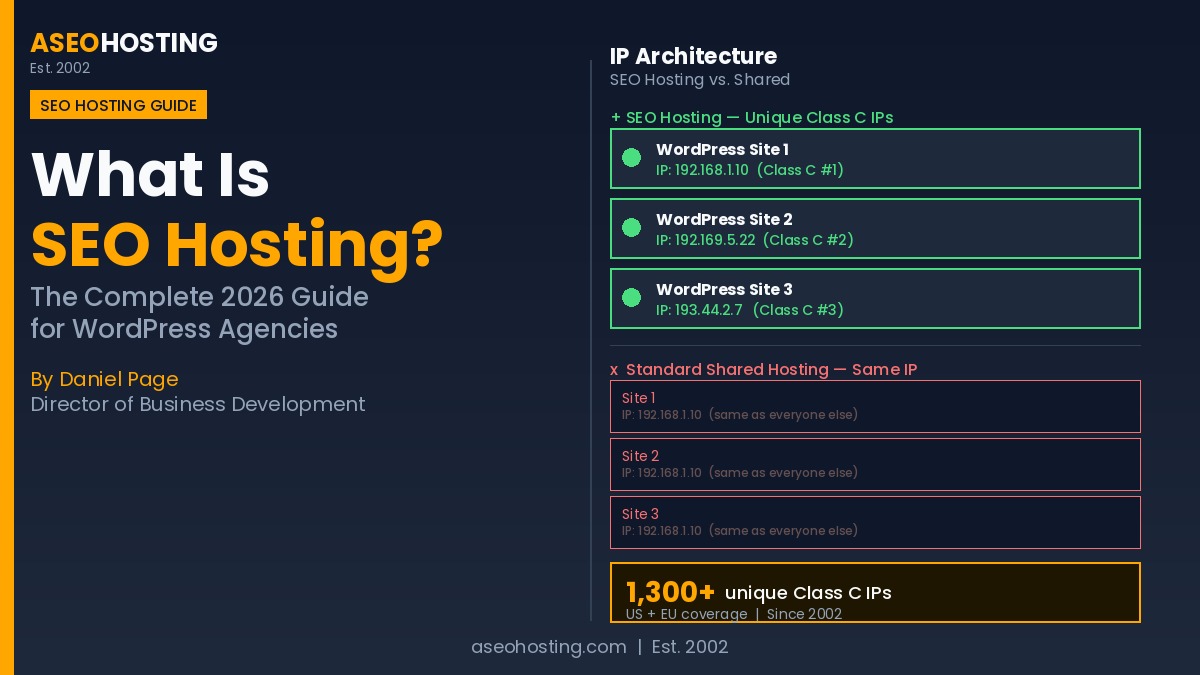
    On a standard shared hosting account, every WordPress site you add resolves to the same IP address. If Site A is at 192.168.1.10 and Site B is also at 192.168.1.10, search engine crawlers see both as living on the same server. That shared-server signal becomes relevant the moment Site A links to Site B: the algorithm knows both ends of the link share the same IP, and in many configurations it applies additional scrutiny to whether that link represents a genuine third-party endorsement or a self-referential arrangement. Furthermore, the value of backlink diversity is rooted in the assumption that links come from genuinely independent infrastructure — a standard shared hosting account undermines that assumption by design. Additionally, even if you never intentionally link between your own sites, the bad-neighbor effect is a separate risk: if another site on that shared IP is flagged for spam or malware, your site inherits a contaminated IP neighborhood whether you know it or not. Notably, WordPress’s own server requirements make no mention of IP configuration — because for a single-site install, it simply does not matter. It only matters the moment your network grows past one domain.

    What Changes When Every Site Gets Its Own Dedicated Class C IP

    In contrast, SEO hosting distributes each domain across a different Class C IP subnet. A Class C subnet is defined by the first three octets of an IPv4 address: 192.168.1.x is one Class C block, 192.168.2.x is a second, and 193.44.7.x is a third — each appearing to infrastructure-level analysis as independent hosting. When your sites live on different Class C ranges, they register to search engine crawlers as genuinely separate web properties, not branches of a single hosting account. Moreover, private nameservers — unique to each domain rather than pointing to a shared nameserver string — reinforce this separation at the DNS level. ASEOHosting provides private nameserver configuration for every account, a step that most standard WordPress hosts do not include as standard and that most experienced SEO operators know to require before they launch any new domain in a managed network. Specifically, configuring ns1.yourdomain.com and ns2.yourdomain.com for each domain removes the shared-nameserver fingerprint that would otherwise link multiple sites to the same hosting account at the DNS query level — well before any IP address is even checked.

    YouTube Video

    The Three IP Classes That Define SEO Hosting Power

    Not all IP diversity is equal. Class C IP variety is the standard entry point for seo hosting, Class B diversity adds another layer of separation, and Class A IP addresses represent the highest-tier differentiation available — the kind enterprise SEO teams and premium authority networks choose when Class C alone is insufficient.

    IP ClassWhat Makes It UniqueSEO ApplicationASEOHosting AvailabilityStarting Price
    Class CThird octet differs (e.g., .1.x vs .2.x vs .3.x)Standard multi-site IP diversity; removes shared-server signal1,300+ unique Class C IPs — US and EU pools$5.75/IP (10–45 IPs/mo)
    Class BSecond and third octets differ (e.g., .168.x vs .169.x)Higher-tier diversity for premium link networksAvailable on VPS and Dedicated Server configurationsBy configuration
    Class AFirst octet differs (e.g., 64.x.x.x vs 193.x.x.x)Maximum infrastructure separation — fewest IP blocks exist globally5–20 A-Class IP packages available$7.00–$9.75/IP (5–20 A-Class IPs/mo)

    Class C IPs — The Foundation of Most WordPress Site Networks

    Typically, Class C IP diversity is where most seo hosting accounts start — and for the majority of SEO agencies and WordPress multi-site operators, it is where they remain, because 1,300+ unique Class C addresses covers virtually every practical use case. ASEOHosting has maintained this IP pool since 2002, serving over 100,000 WordPress sites across its US and EU infrastructure. That scale means no two client domains need to share a Class C range, and no client’s link profile needs to reveal a shared-server fingerprint. The pricing tiers reward volume: agencies managing 10 to 45 sites pay $5.75 per IP monthly; networks of 50 to 190 sites drop to $4.75 per IP; and networks of 200 or more sites drop further to $4.25 per IP. For most active client rosters, the 50-IP tier at $237.50 per month is the clearest value point — enough diversity for an active agency, at a per-IP rate that beats the entry tier by a full dollar per address. Explore ASEOHosting’s shared SEO hosting plans to compare current IP-count options across both US and EU pools.

    Class A IPs — The Premium Choice for High-Stakes Authority Sites

    Indeed, Class A IP addresses carry the strongest infrastructure separation signal: their first octets differ, meaning two Class A IPs might look like 64.x.x.x and 193.x.x.x — networks that are geographically and organizationally distinct at the broadest possible level. That degree of separation matters most when operating authority sites in premium niches where every link signal carries outsized weight. ASEOHosting offers Class A IP packages starting at $35 for five A-Class IPs, scaling to $195 for 20 A-Class IPs. For the most competitive authority-building campaigns, pairing a core Class C network with a handful of Class A IPs on your highest-priority properties adds an infrastructure diversity layer that Class C alone cannot provide. In practice, most agencies use Class A IPs selectively — reserved for a handful of top-tier properties — while running the broader site network on Class C addresses.

    IP Architecture Comparison: Shared Hosting vs. SEO Hosting Left panel shows three WordPress sites all linking to one shared IP address (bad-neighbor risk). Right panel shows three WordPress sites each on their own unique Class C IP address (isolated and independent). IP Architecture Comparison Standard Shared Hosting WordPress Site 1 WordPress Site 2 WordPress Site 3 SHARED IP 192.168.1.10 x Bad-neighbor risk x Links may be discounted x Shared IP = shared reputation ASEOHosting SEO Hosting WordPress Site 1 WordPress Site 2 WordPress Site 3 UNIQUE IP 192.168.1.10 UNIQUE IP 192.169.5.22 UNIQUE IP 193.44.2.7 + Full link signal integrity + Client sites fully isolated + 1,300+ unique Class C IPs Source: ASEOHosting.com — IP-diverse WordPress hosting since 2002
    Figure 1: On standard shared hosting all sites share one IP; on ASEOHosting SEO hosting every domain gets its own dedicated Class C IP address.

    Who Actually Needs SEO Hosting in 2026 (And Who Does Not)

    SEO hosting delivers specific benefits to specific use cases. Agencies managing multiple client WordPress sites, international operators targeting multiple country SERPs, and multi-site WordPress managers building topical authority networks are the primary audiences. A small business running a single WordPress domain does not need it — and would pay significantly more than standard hosting offers without a corresponding benefit. Understanding which side of that line you sit on is the starting point for every seo hosting decision.

    SEO Agencies: Client Site Isolation from Bad-Neighbor IP Penalties

    For SEO agencies, the primary reason to use WordPress SEO hosting is often not link building at all — it is client isolation. When a client’s WordPress site shares an IP address with another client’s site, any spam, malware, or algorithmic penalty affecting one can contaminate the IP reputation for both. That is an agency liability issue, not merely an SEO inconvenience. Consequently, placing each client domain on its own dedicated Class C IP address removes that shared-fate risk entirely. If a client account is compromised or faces a manual action, the IP signal stays contained to that account. Every other client account on your ASEOHosting plan continues operating from its own clean, isolated IP address — with no exposure to whatever is happening next door. That client protection argument is one most clients understand immediately once it is explained in plain terms.

    International WordPress Operators: Geo-Targeted IPs Across US and EU

    Similarly, for businesses targeting search results in specific countries, server IP geolocation remains a meaningful signal. Google’s SEO guidance acknowledges that server location contributes to how search engines determine geographic relevance, particularly for country-specific results. A WordPress site hosted on a US IP address competing for German or Swedish SERPs carries a geographic disadvantage that an EU-hosted IP helps neutralize. ASEOHosting operates both US and EU IP pools — offering both US and EU coverage from a single account. That means you can place a German-targeted site on an EU Class C IP while keeping your US properties on US Class C ranges, all managed through one ASEOHosting account. In 2026, combining a country-code TLD with a geographically appropriate IP address continues to be the strongest available geographic relevance signal for international WordPress operators.

    Multi-Site WordPress Managers Building Topical Authority Networks

    Furthermore, for WordPress operators managing topical content networks — clusters of themed sites that collectively build authority in a vertical — IP diversity reduces the infrastructure footprint that connects those sites at the network level. As we covered in our post on how hosting affects LLM visibility, 2026 search increasingly includes AI-powered systems that evaluate source credibility at the infrastructure level. IP diversity is not the only variable: fast load times, unique content, independent analytics accounts, and genuine topical quality all matter far more than IP configuration alone. That said, IP diversity handles the infrastructure signal cleanly, so that your content and link quality carry the ranking conversation rather than a detectable shared-server pattern undermining it before your content is even evaluated.

    SEO Hosting vs. Standard WordPress Hosting: What You Actually Get

    The core difference is not performance or support — it is IP architecture. Standard WordPress hosting wins on simplicity and price for single-site owners; seo hosting wins on IP diversity, private nameservers, and client isolation for multi-site operators and agencies. The table below maps the key feature differences side by side.

    FeatureStandard WordPress HostingASEOHosting SEO Hosting
    IP per domainShared — hundreds of sites per IPDedicated Class C IP, yours alone
    Class C IP varietyNone1,300+ unique Class C IPs
    Private nameserversRarely includedIncluded on every account
    Client site isolationNot possible on shared IPFull per-account IP isolation
    EU geo-targeted IPsNot availableUS + EU coverage from one account
    WordPress installationOne-click (varies by host)One-click via Softaculous
    Free site migrationVaries by providerIncluded from any cPanel host
    IP Manager ToolNo equivalentOne-click IP reassignment
    Uptime SLAVaries (typically 99.9%)99.9% guaranteed
    Starting priceFrom approx. $3/mo shared IPFrom $57.50/mo (10 dedicated IPs)

    In practice, the price difference between standard shared hosting and seo hosting is the price of IP diversity. If your use case does not require IP separation — you run one WordPress site, one client, one domain — standard hosting is the right tool. However, if IP footprint affects your results or your client relationships, seo hosting is the specific infrastructure product built to solve it. There is no general-purpose hosting plan that provides 1,300+ unique Class C IPs by design — that architecture requires a hosting provider whose entire business model is built around it.

    How to Choose the Right ASEOHosting Plan for Your WordPress Network

    The right ASEOHosting plan depends on how many WordPress sites you manage and where you need them located. The estimator below maps your site count to the appropriate plan tier and monthly price in real time. For US-targeted sites, the standard seo hosting plans apply; for European SERPs, the SEO VPS or EU shared plans extend the same Class C diversity to European datacenter IP ranges.

    IP Plan Estimator — Find Your ASEOHosting Tier

    Additionally, ASEOHosting’s IP Manager Tool is worth understanding specifically: it lets you reassign any Class C IP to any domain in your account with a single click, without opening a support ticket. No other multiple-IP seo hosting provider offers an equivalent self-service interface. If a site needs to be moved to a fresh Class C IP range, the IP Manager handles the reassignment immediately. For agencies onboarding new clients or offboarding departing ones, that operational flexibility makes IP management genuinely practical rather than a recurring support overhead. See also our overview of how diverse IP hosting supports WordPress and AI search performance for context on why IP configuration matters beyond traditional SEO in 2026.

    Frequently Asked Questions: SEO Hosting

    Does seo hosting actually work in 2026, or has Google gotten too smart to care about IP diversity?

    Specifically, seo hosting continues to work in 2026 for its core purpose: removing the shared-IP infrastructure footprint that can discount link equity between sites you operate. Google has never confirmed IP diversity as a direct ranking signal — the mechanism is protective, not promotional. Shared-IP link relationships are a detectable pattern; unique Class C IPs at the per-domain level remove that pattern. For SEO agencies managing client site isolation and multi-site operators building linked domain networks, that infrastructure-level separation still eliminates the most reliably detectable footprint signal available to crawlers.

    SEO hosting vs shared hosting: what’s the actual difference, and which should a WordPress agency use?

    Fundamentally, the difference is IP architecture. Standard shared hosting places every domain in your agency’s account on the same IP address — 20 client sites share one IP, making the server relationship visible to search engine crawlers. SEO hosting assigns each domain its own dedicated IP from a unique Class C subnet, so every client site appears as independent infrastructure. For a WordPress agency, that means links between client properties carry independent signal value, and a penalty or malware flag on one client’s IP cannot contaminate another’s reputation on the same account.

    Does Google penalize websites that share the same IP address in 2026?

    Importantly, Google does not issue algorithmic penalties for shared IP addresses in 2026. Google engineers including John Mueller and Matt Cutts have confirmed that Google evaluates sites individually and understands that shared hosting is common. The real risk is subtler: when multiple sites on the same IP interlink, Google can detect the shared-server relationship and apply additional scrutiny to whether those links represent genuine third-party endorsements. The documented outcome is link equity discounting rather than ranking penalties — but for agencies whose business model depends on link signal integrity between client sites, that distinction matters considerably.

    If I manage 30 client WordPress sites on ASEOHosting, does each domain need its own unique Class C IP?

    Accordingly, yes — one unique Class C IP per domain is the correct baseline for seo hosting. With 30 client sites, you need at minimum 30 unique Class C addresses, each assigned to a separate domain in your ASEOHosting account. In practice, most agencies at 30 sites choose the 50-IP tier at $237.50 per month, which provides 20 reserve IPs for onboarding new clients and IP reassignment without waiting on new allocations. Moving from 45 to 50 IPs also drops the per-IP rate from $5.75 to $4.75 monthly.

    What is a Class C IP address and why does it matter for seo hosting?

    Specifically, a Class C IP address is an IPv4 address where the first three octets identify the network block — so 192.168.1.x and 192.168.2.x are two distinct Class C networks, even though their first two octets match. For seo hosting, Class C diversity matters because search engines use IP-level signals to infer infrastructure relationships between domains. Sites sharing the same Class C subnet carry a detectable server fingerprint; sites on different Class C ranges appear as independent infrastructure to search engine crawlers. That is why ASEOHosting maintains over 1,300 unique Class C IP blocks rather than allocating customers from a single datacenter subnet.

    SEO hosting vs VPS hosting: which gives better IP diversity for a 30-site WordPress network?

    In contrast, seo hosting delivers significantly better IP diversity than a VPS for a 30-site WordPress network. A standard VPS provides one dedicated server with one IP address — or a small range from the same datacenter subnet. A 50-IP ASEOHosting seo hosting plan provides 50 unique Class C addresses drawn from over 1,300 distinct IP blocks, with each client domain appearing to crawlers as hosted on entirely separate infrastructure. VPS hosting solves resource isolation for a single high-traffic site; it does not solve IP-footprint diversity at the per-domain scale a multi-client agency requires.

    Notably, the bad-neighbor IP effect describes the risk a clean website incurs from co-hosting on an IP address already associated with spam, malware, or manipulative linking. Search engines use IP-level signals to infer infrastructure relationships, and when a shared IP is contaminated by one problematic site, other sites on that address can see their trust signals suppressed and their link equity relationships evaluated with additional scrutiny — even if those sites themselves are entirely clean. The effect is most pronounced for link equity between interlinked sites on the same IP, where the shared-server relationship is already detectable by crawlers regardless of each site’s individual content quality.

    If I move a WordPress site to a new Class C IP on ASEOHosting, will Google re-crawl it as if it’s a new domain?

    Fortunately, changing a WordPress domain’s IP address via ASEOHosting’s IP Manager does not reset Google’s crawl history or treat the domain as new. Google indexes URLs, not IP addresses, so the domain’s existing indexed pages, rankings, and crawl schedule remain intact after an IP reassignment. What changes is the infrastructure signal: the new Class C IP removes any shared-server associations the previous IP carried with neighboring sites or prior reputation issues. ASEOHosting’s IP Manager processes the reassignment with a single click; DNS propagation typically completes within 24 to 48 hours.

    Does ASEOHosting’s private nameserver setup matter for seo hosting, or do only the Class C IPs count?

    Indeed, private nameservers matter for seo hosting alongside Class C IP diversity — they address a separate but equally detectable infrastructure signal. When multiple domains share the same nameserver strings such as ns1.hostprovider.com, that shared nameserver fingerprint links those domains together even when their Class C IPs are all unique. ASEOHosting’s private nameserver setup assigns domain-specific nameservers — ns1.yourdomain.com and ns2.yourdomain.com — to each account, removing the shared-nameserver signal at the DNS level. Properly configured seo hosting requires both layers: unique Class C IPs at the hosting level and private nameservers at the DNS level.

    Does a dedicated IP address actually improve SEO rankings?

    Overall, a dedicated IP address does not directly improve SEO rankings on its own. Google has confirmed through statements from engineers John Mueller and Matt Cutts that it does not use IP type as a ranking signal for standard single-site hosting. The SEO case for dedicated IPs applies specifically to multi-site contexts: when unique Class C IPs are assigned per domain in a linked site network, they remove a detectable infrastructure footprint that can cause link equity to be discounted — not through a ranking bonus, but by eliminating a signal that would otherwise suppress it.

  • AI Citation Volatility: Why Your Site Disappears From AI

    AI Citation Volatility: Why Your Site Disappears From AI

    Listen to Podcast

    How to Thrive in the New Digital Visibility Landscape

    Introduction: The Ground is Shifting

    Everyone’s obsessed with rankings. Page one or bust, right? But that’s just it—rankings are no longer the only game in town. Thanks to Large Language Models (LLMs) like Google AI Mode, Perplexity, and ChatGPT, the battleground for visibility has moved.

    And here’s the kicker: what gets cited by AI search today might vanish tomorrow.

    If you’ve ever noticed your site mentioned in an AI-generated answer one month and completely missing the next, you’ve experienced what’s now being called AI citation volatility. The truth is, this isn’t just some passing quirk. It’s a fundamental change in how visibility works.

    Let me explain.

    (more…)
  • Invisible SEO Metric: How Hosting Affects LLM Visibility.

    Invisible SEO Metric: How Hosting Affects LLM Visibility.

    Home » AI – LLMs

    Table of Contents

    Listen to Podcast

    Why Your Hosting is the New Frontier for AI Visibility

    Let’s face it—everyone’s talking about ranking. Page one or bust, right?

    But that’s just it. The landscape has shifted.

    Thanks to Large Language Models (LLMs) like ChatGPT, Perplexity, Gemini, and even Google’s own AI Mode (AP News), the future of SEO isn’t just about climbing SERPs. It’s about becoming citable by AI systems. Welcome to the age of LLM Visibility.

    And here’s the twist: your hosting environment might be playing a far bigger role than you think.


    What Is LLM Visibility, and Why Should You Care?

    (more…)
  • Unlock SEO Power with AI, WordPress & Diverse IP Hosting

    Unlock SEO Power with AI, WordPress & Diverse IP Hosting

    Navigating the Digital Landscape: May 2025 Insights

    Let’s face it—keeping up with digital trends can feel like trying to hit a moving target. But staying updated isn’t optional anymore; it’s the price of admission. Just this past month, May 2025 rolled out a cascade of updates in AI, SEO, and WordPress that—if you’re paying attention—could change the way you build and optimize your presence online.

    Let me explain.


    AI’s Expanding Role in Search and Beyond

    Google’s AI Mode: Redefining Search Interactions

    (more…)
  • What the Twitter Fiasco Can Teach Us for SEO!

    What the Twitter Fiasco Can Teach Us for SEO!

    When business magnate Elon Musk offered to purchase Twitter in April 2022, many thought it was a late April Fool’s joke. Unfortunately, this was not the case. Several months and a brief lawsuit later, Musk is now the new owner of a social network—and also $44 billion poorer. 

    Things seem to have gone downhill since then. Notable highlights include:

    Twitter Fiasco timeline
    Twitter harm for seo
    (more…)
  • Why You Can’t Be an Effective SEO Professional Without Being a Skilled Researcher

    Why You Can’t Be an Effective SEO Professional Without Being a Skilled Researcher

    Quick question: what skill is the most crucial indicator of success in search engine optimization? 

    You might think it’s critical thinking, that you need an analytical mind and the capacity to parse and understand search analytics. You may think communication and social skills are key, as a good SEO professional needs to be able to not only communicate the results of their work, but also use that work to generate compelling content. Alternatively, you might point to the fact that, as an inherently technical pursuit, a skilled SEO professional needs to be tech-savvy. 

    (more…)
  • Search Engine Optimization Is Not A Magic Bullet. You Need to Understand Its Limitations

    Search Engine Optimization Is Not A Magic Bullet. You Need to Understand Its Limitations

    We’ve all met at least one search engine optimization (SEO) snake oil salesman. You know the type. 

    Grandiose and sweeping promises. Language bogged down with so much jargon it’s functionally meaningless. An endless barrage of gaslighting and cold opens. 

    To hear these people talk, SEO is some sort of mystic art, and mastery means you’re guaranteed to dominate the search engine results page (SERP). 

    Anyone who’s spent even a little time studying the craft knows this to be a blatant lie. SEO is valuable, indeed—it’s a powerful lead generation and marketing tool in the right hands. But it’s not some secret weapon, and it won’t allow you to seize control of Google’s algorithms. 

    In order to leverage it effectively, you need to accept that—you need to understand the limitations of SEO.

    (more…)
  • Attract the Right Customers at Every Stage with Strategic SEO

    Attract the Right Customers at Every Stage with Strategic SEO

    A sales funnel—also known as a conversion funnel or a marketing funnel—is basically a visual representation of the different stages a prospect goes through before converting. Within the context of search engine optimization, converting could be anything from purchasing a product to signing up for a newsletter to simply accessing a specific page on your site. Most funnels consist of some version of the following stages: 

    • Awareness. People at this stage may or may not know about your company. This is where the majority of your prospects start and where most will likely remain. 
    • Interest. These prospects are intrigued but not necessarily hooked just yet. They’ve probably spent a bit of time on your website looking at what you have to offer. 
    • Consideration. People at this stage are doing their research into both your company and its competitors in an effort to decide who to choose. 
    • Decision. The tipping point. These prospects are on the verge of converting.
    • Conversion. The people at this stage have done what you wanted them to do, but you aren’t finished yet. Now you need to put time and effort into nurturing a relationship with those customers in order to keep them loyal—and maybe inspire them to tell their friends and colleagues about your business, too. 
    (more…)
  • Lost Traffic, Lost Rankings: The Cost of Ignoring Your Users

    Lost Traffic, Lost Rankings: The Cost of Ignoring Your Users

    There was a time when search engine optimization(SEO) was all about gaming the algorithm. A time when keyword density and backlinks were the exclusive determining factors in where one appeared on the search engine results page(SERP). But that was decades ago. 

    Modern SEO is different. It’s less algorithm-focused and more user-focused. Keywords are still important, certainly—but not more important than creating relevant, high-quality content. 

    The problem is that too many so-called SEO agencies ignore this shift. They obsess over pointless metrics like what percentage of a blog post consists of primary and secondary keywords. And in the process, they ignore content quality. 

    (more…)