- How Many Class C IPs Do I Need? The Short Answer (And the Real Median)
- The One-Domain-One-Class-C Rule (And Where Buyers Get the Math Wrong)
- Sizing by Operator Type: Agency, Multi-Site Owner, International
- How Many Class C IPs Do I Need at Each Portfolio Size? The Cost Math
- Buy for Today or Buy for Growth? The 40% Upgrade Signal
- Class C IP Sizing: The Decision at a Glance
- The Class C IP Sizing Calculator
- Sizing Checklist: Are You Buying the Right Number of Class C IPs?
- Frequently Asked Questions: How Many Class C IPs Do I Need
- How many class c ips do i need for a 10-site WordPress network in 2026?
- What is the average number of Class C IPs that SEO hosting customers actually order?
- How many class c ips do i need vs how many IP addresses are in a /24 subnet in 2026?
- Class C IP diversity vs a single dedicated IP: which does a 5-site portfolio need?
- When should an agency buy more than 21 diverse Class C IPs on ASEOHosting in 2026?
- How many class c ips do i need if my sites target both US and European search results?
- Does every IP in an ASEOHosting plan come from a different Class C range?
- How many Class C IPs on ASEOHosting before Class A IP diversity becomes worth the cost?
- How many class c ips do i need today vs for planned growth?
- How many class c ips do i need reddit answers suggest, and are they right?
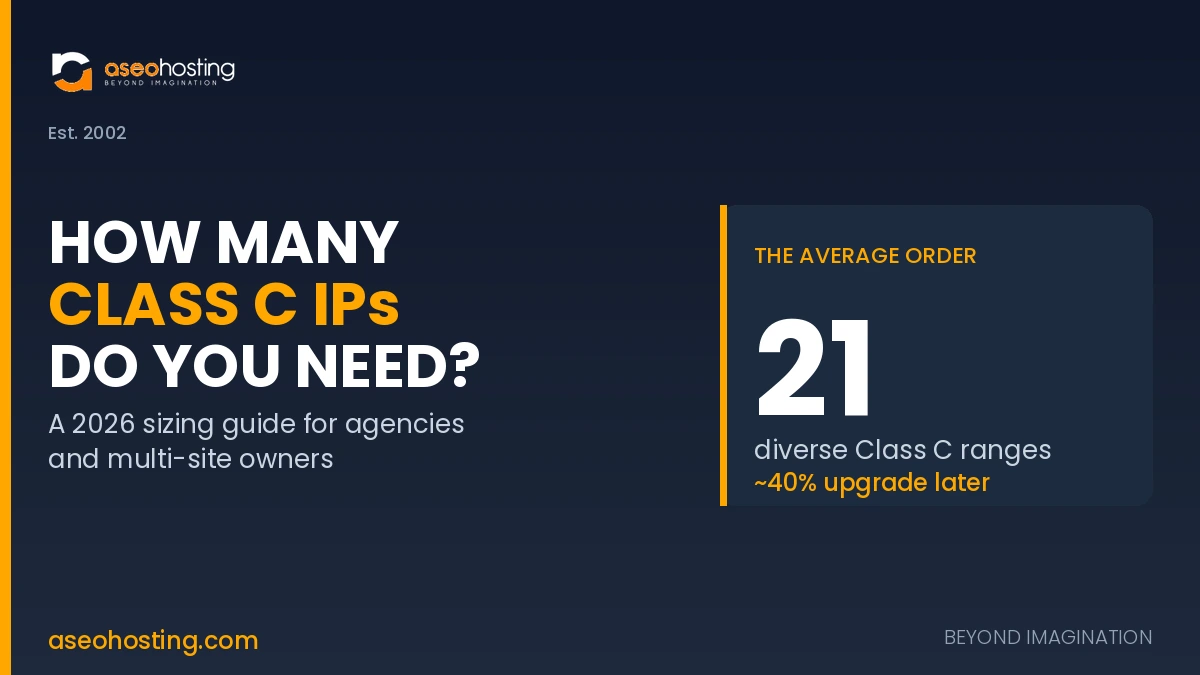
Asking how many class c ips do i need? Buy one diverse Class C per interlinking domain. The average ASEOHosting order is 21 ranges, and roughly 40% of customers upgrade later — so size for today, not for a hypothetical network.
Every operator building a site network eventually asks the same purchasing question: how many class c ips do i need? Furthermore, almost nobody answers it with a number. Search the phrase and you will find definitional guides explaining what an octet is, philosophical essays arguing that IP diversity no longer matters, and vendor pages quoting a per-IP rate without ever telling you how many to put in the cart. Consequently, buyers end up on Reddit asking strangers to guess at their infrastructure budget.
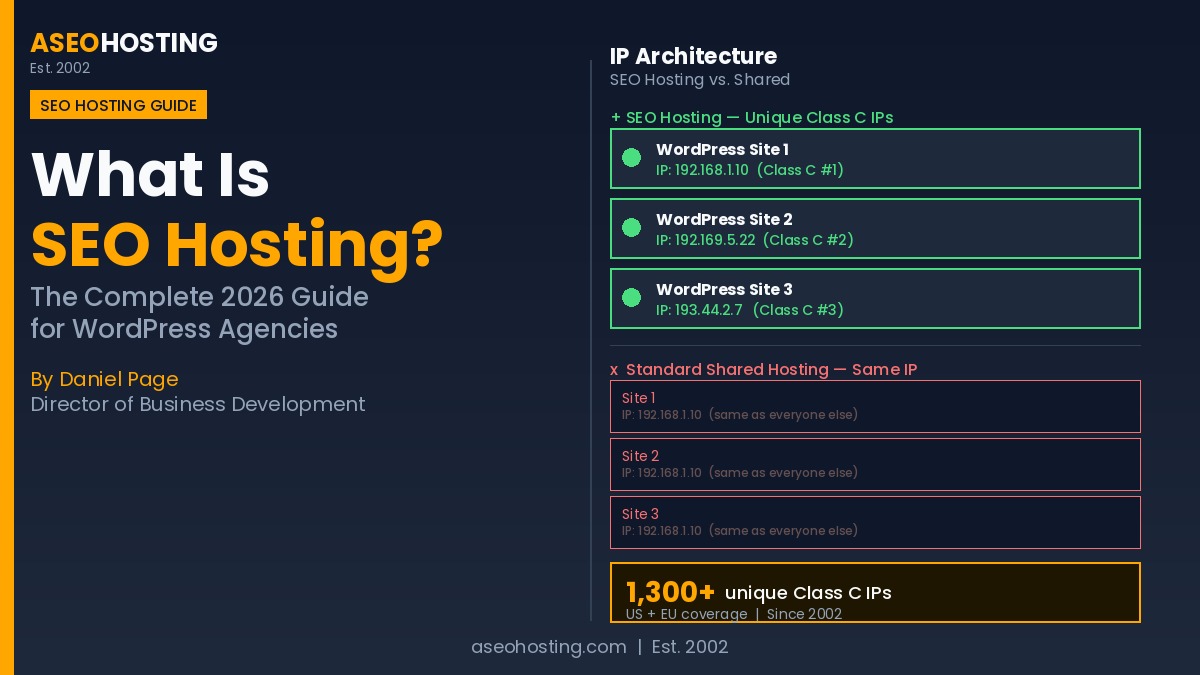
Therefore, this guide takes the opposite approach. Rather than relitigating whether Class C diversity is worth buying — a question our complete guide to what SEO hosting actually is already settles — it answers the sizing question directly, using the one input no competitor page contains: what operators actually order.
How Many Class C IPs Do I Need? The Short Answer (And the Real Median)
Specifically, you need one diverse Class C range for every domain that links to another domain you own. Sites that never reference each other do not need diversity at all. That single rule resolves the majority of sizing questions, because the cost of Class C diversity buys exactly one thing: the separation of link signals between properties under common control.
However, a rule without a benchmark is still guesswork. Accordingly, here is the number that no other page on this topic publishes. Across ASEOHosting orders, the average purchase is 21 diverse Class C ranges, rounding down. Moreover, approximately 40% of customers later upgrade as their business or productivity grows. Those two figures reframe the entire question — 21 is what the market actually buys, and expanding later is the norm rather than a planning failure.
The ASEOHosting Class C Sizing Matrix
Notably, the matrix below maps portfolio size to a recommended diverse Class C count, benchmarked against the 21-IP median and against the available range ceiling. It assumes interlinking domains; non-interlinking portfolios drop to the far-right column.
| Portfolio profile | Interlinking domains | Diverse Class C IPs needed | vs. 21-IP median | If sites never interlink |
|---|---|---|---|---|
| Single business site | 0 | 1 (dedicated, not diverse) | 5% | 1 |
| Small brand cluster | 2–5 | 2–5 | 10–24% | 1 |
| Multi-site owner | 6–20 | 6–20 | 29–95% | 1 |
| Median operator | 21 | 21 | 100% | 1 |
| Growing agency | 22–75 | 22–75 | 105–357% | 1–3 |
| Established agency | 76–150 | 76–150 | 362–714% | 3–5 |
| Large network operator | 151–800 | 151–800 (US pool) | 719–3,810% | 5+ |
| Global network operator | 801–1,300 | Up to ~1,300 (incl. international) | Ceiling | 5+ |
In practice, the right-hand column is the one that saves people money. A portfolio of 40 sites that never link to each other does not need 40 diverse ranges — it needs one dedicated IP and a better content strategy.
The One-Domain-One-Class-C Rule (And Where Buyers Get the Math Wrong)
Fundamentally, the sizing rule is one diverse Class C per interlinking domain, and the most expensive mistakes come from misreading what “diverse” means at the subnet level. Two confusions account for nearly every oversized and undersized order.
Why “How Many IPs in a /24 or /26” Is the Wrong Question Entirely
Importantly, searchers asking how many class c ips do i need very often arrive by way of a subnet-math question — how many addresses live in a /24, a /26, or a /27. Those are legitimate networking questions with precise answers, and they are irrelevant to this purchase. A /24 holds 256 addresses with 254 usable hosts; a /26 holds 64 with 62 usable; a /27 holds 32 with 30 usable. The IETF specification for Classless Inter-Domain Routing replaced the original class system decades ago, which is why the terms survive in SEO vocabulary long after they stopped describing how addresses are actually allocated.
Consequently, here is the distinction that matters commercially. Those 254 usable addresses inside a single /24 all share the same first three octets. Therefore they are one Class C range, not 254 of them. Buying a block of consecutive addresses delivers volume, not diversity — and diversity is the only thing a site network is paying for. Meanwhile, the IANA number resource registry documents how those address blocks are delegated to regional registries in the first place, which is what makes genuinely distinct ranges a finite and allocated resource rather than something a host can conjure on demand.
One IP, One Distinct Class C: How ASEOHosting Allocates
Specifically, every IP in an ASEOHosting plan is drawn from a different Class C range, subject to availability at the time of order. In contrast, a provider that fills an order with consecutive addresses from one subnet has sold volume while delivering a single point of infrastructural correlation. Furthermore, that allocation model is what sets the practical ceiling: roughly 800 diverse US-based ranges, or approximately 1,300 diverse ranges overall once international allocations are included. Regional distribution of those blocks is coordinated through registries such as ARIN’s number resource request process in North America, which is precisely why a deep pool of genuinely non-adjacent ranges is difficult to assemble and rarely offered at scale.
Sizing by Operator Type: Agency, Multi-Site Owner, International
Typically, three operator profiles account for nearly all genuine demand, and each sizes on a different variable. Identifying which one you are shortens the decision considerably.
Agencies: Client Isolation Drives the Count, Not Site Count
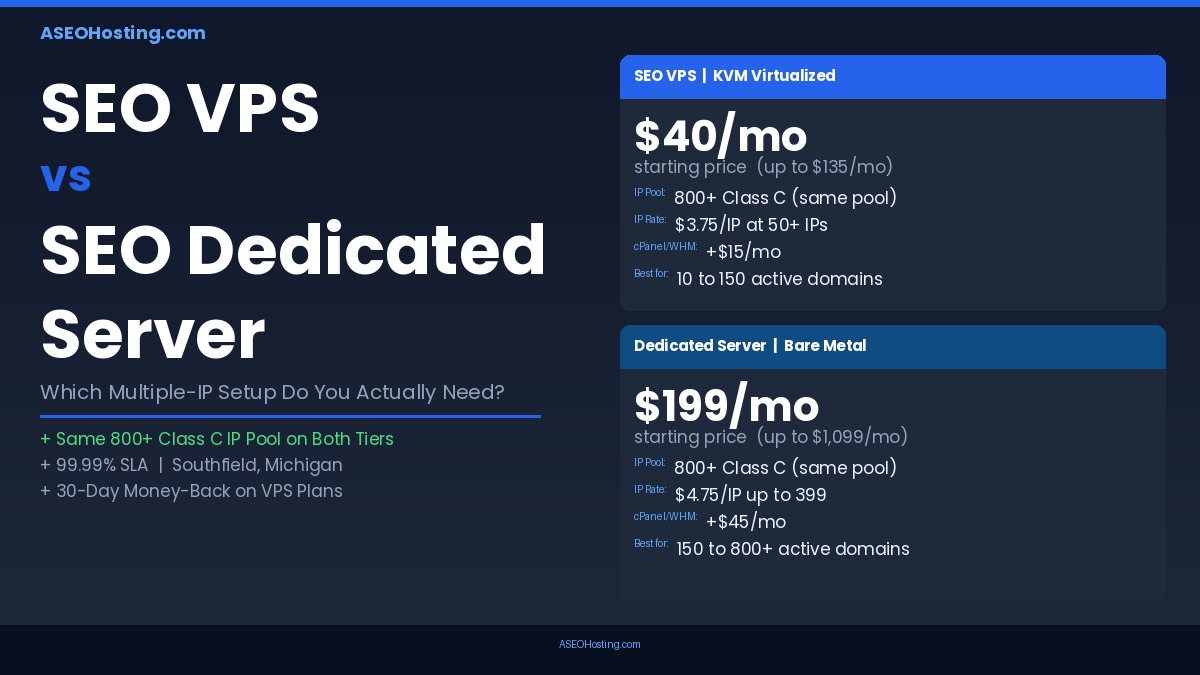
For agencies, the sizing variable is exposure, not headcount. Additionally, the operative question is what happens when one client site is flagged, penalized, or compromised. If that event would place other clients on the same infrastructure at risk, then isolation stops being a technical preference and becomes a contractual obligation. Consequently, agencies size to their client roster rather than to their interlinking map, and they tend to land above the 21-IP median well before they feel large. Our breakdown of multiple-IP SEO hosting plans and per-IP pricing sets out where each roster size lands.
Multi-Site Owners: Topical Authority Networks and the Interlinking Test
By contrast, multi-site owners size strictly on interlinking. Moreover, the test is mechanical: list every domain you control, then draw an arrow wherever one links to another. Every domain with an arrow attached needs its own diverse Class C. Every isolated domain needs nothing but a reliable dedicated IP. In practice, this exercise routinely cuts a proposed order in half, because operators discover that most of their portfolio does not actually interlink at all. Additionally, for networks built to establish topical authority rather than to pass link equity, our earlier analysis of diverse IP hosting as an SEO lever covers why infrastructure separation still carries weight even where interlinking is light.
International Operators: Why the 800 US and 1,300 Global Ceiling Matters
Meanwhile, geo-targeted networks size on markets multiplied by domains. Furthermore, Google’s guidance on multi-regional sites is explicit that server location is one of several signals used to associate a site with a region, alongside country-code domains and hreflang annotations. Therefore an operator running parallel US and European properties draws from both pools — approximately 800 diverse US-based ranges and roughly 1,300 diverse ranges in total including international allocations. Notably, that headroom is the constraint worth checking before committing to a market-expansion roadmap, and it is the reason the sizing matrix caps where it does.
Additionally, European allocations are administered under a separate regional registry entirely, and RIPE NCC’s IPv4 allocation policy documents just how constrained the remaining European address space has become. Consequently, genuinely diverse EU ranges are scarcer than their US equivalents — which is why an international network should confirm range availability before finalizing a market roadmap rather than after.
How Many Class C IPs Do I Need at Each Portfolio Size? The Cost Math
Ultimately, sizing decisions get made against a budget, so the count has to translate into a monthly figure. Accordingly, the table below prices each band of the sizing matrix and maps it to the product tier that carries it.
| Diverse Class C IPs | Operator profile | Indicative monthly IP cost (from $3.75/IP) | Product tier that carries it |
|---|---|---|---|
| 5 | Entry / small cluster | from ~$19 | Shared SEO hosting |
| 10 | Multi-site owner | from ~$38 | Shared SEO hosting |
| 21 | Median order | from ~$79 | Shared SEO hosting |
| 50 | Growing agency | from ~$188 | Shared or SEO VPS |
| 150 | Established agency | from ~$563 | SEO VPS |
| 300+ | Large network operator | from ~$1,125 | SEO Dedicated Server |
Notably, the per-IP rate is flat while the server underneath it is not. Consequently, once a network passes roughly 150 active domains, the binding constraint stops being IP cost and starts being server resources — a threshold examined in detail in our comparison of the SEO VPS and dedicated server multiple-IP tiers. For networks that have already crossed it, the root-access SEO VPS configurations are the natural next step.
Buy for Today or Buy for Growth? The 40% Upgrade Signal
Fortunately, this is the easiest decision in the entire purchase, and the answer runs against the vendor’s short-term interest: buy for today. Approximately 40% of ASEOHosting customers upgrade later as their business or productivity grows, which tells you something important about how this market actually behaves. Expansion is routine, not exceptional.
Therefore, pre-buying diverse Class C ranges for domains that do not exist yet converts a future decision into a present cost with no offsetting benefit. Additionally, ranges are allocated per order rather than held in reserve, so an unused IP is not a reserved IP. In other words, the 40% upgrade rate is not evidence that customers under-bought — it is evidence that sizing to current reality and expanding on demand is the working pattern of the operators who succeed.
Similarly, this is why the interlinking test matters more than any growth projection. A network of 12 interlinking domains needs 12 diverse ranges today. Whether it becomes 40 domains next year is a question best answered by next year’s order, particularly for operators running WordPress at scale who can provision incrementally on WordPress-optimized SEO hosting as each new property launches.
Class C IP Sizing: The Decision at a Glance
Specifically, the infographic below compresses the entire sizing logic into a single decision path, from interlinking test through to product tier.
The Class C IP Sizing Calculator
Finally, the calculator below applies every rule in this guide to your own portfolio. Additionally, it benchmarks the result against the 21-IP median order so you can see immediately whether you are sizing above or below what operators typically buy.
Class C IP Sizing Calculator
Answer three questions. Get your number, benchmarked against the 21-IP median order.
10
Diverse Class C IPs recommended
Tier: Shared SEO Hosting
Indicative IP cost: from ~$38/mo
That is 48% of the 21-IP median ASEOHosting order.
Configure a dedicated SEO serverSizing Checklist: Are You Buying the Right Number of Class C IPs?
Above all, run this checklist before placing an order. In practice, it catches the two failure modes that account for most sizing errors — paying for diversity that delivers nothing, and under-provisioning a network that genuinely interlinks.
- Interlinking mapped. Every domain that links to another domain you own has been counted; isolated domains have been excluded.
- Diversity understood. You are buying distinct Class C ranges, not consecutive addresses inside one subnet.
- Median benchmarked. Your count has been compared against the 21-IP average order — well above or well below both warrant a second look.
- Geo-targets counted. Multi-region networks have multiplied domains by target markets, not just counted domains.
- Growth deferred. You are sizing for domains that exist today, not for the network you intend to build next year.
- Headroom confirmed. Large orders have been checked against the ~800 US and ~1,300 total diverse-range ceiling.
- Server tier matched. Networks above roughly 150 active domains have been evaluated for server resources, not just IP count.
Ultimately, the honest answer to how many class c ips do i need is smaller than most buyers fear and easier to change than most buyers assume. Consequently, the 40% who upgrade later are not the ones who made a mistake — they are the ones who sized correctly the first time and grew into the next order.
Frequently Asked Questions: How Many Class C IPs Do I Need
How many class c ips do i need for a 10-site WordPress network in 2026?
Specifically, a 10-site WordPress network needs 10 diverse Class C IPs when those sites interlink, and as few as 1 when they do not. The count is driven by interlinking, not by site count. Furthermore, 10 sits well below the 21-IP median order, which places a 10-site network in the entry band of the ASEOHosting Class C Sizing Matrix in this guide.
What is the average number of Class C IPs that SEO hosting customers actually order?
Specifically, the average ASEOHosting order is 21 diverse Class C ranges, rounding down. Moreover, approximately 40% of customers later upgrade as their business or productivity grows. That median is the single most useful benchmark for anyone asking how many class c ips do i need, because it reflects what operators actually buy rather than what vendors recommend.
How many class c ips do i need vs how many IP addresses are in a /24 subnet in 2026?
Importantly, these are two different questions that searchers frequently conflate. A /24 subnet contains 256 addresses, of which 254 are usable hosts. However, the sizing question is about how many distinct Class C ranges you hold, not how many addresses sit inside one range. Consequently, buying 254 IPs inside a single /24 delivers zero diversity value for a site network.
Class C IP diversity vs a single dedicated IP: which does a 5-site portfolio need?
Typically, a 5-site portfolio that does not interlink needs only a single dedicated IP, while a 5-site portfolio built to pass link signals between properties needs 5 diverse Class C ranges. In other words, diversity is only purchased when sites reference each other. The interlinking test in the sizing checklist below settles the question in under a minute.
When should an agency buy more than 21 diverse Class C IPs on ASEOHosting in 2026?
Notably, an agency should exceed the 21-IP median once it manages more than 21 interlinking client properties, or once client isolation becomes contractual rather than optional. In practice, agencies cross this line when a single flagged client site would place other clients at risk. Additionally, the 40% ASEOHosting upgrade rate confirms most operators reach this threshold after launch, not before it.
How many class c ips do i need if my sites target both US and European search results?
Generally, geo-targeted networks need one diverse Class C per domain per target market, which raises the count above a purely domestic portfolio of the same size. Furthermore, ASEOHosting maintains roughly 800 diverse US-based ranges and approximately 1,300 diverse ranges including international allocations, so a mixed US and EU network draws from both pools rather than exhausting either.
Does every IP in an ASEOHosting plan come from a different Class C range?
Specifically, yes. Every IP is allocated from a different Class C range, subject to availability at the time of order, up to approximately 800 diverse US-based ranges or roughly 1,300 diverse ranges overall including international. In contrast, many providers count consecutive addresses inside one subnet as separate IPs, which delivers no diversity at all.
How many Class C IPs on ASEOHosting before Class A IP diversity becomes worth the cost?
Typically, Class A diversity becomes a genuine consideration only above the median ASEOHosting order, once a network is large enough that first-octet clustering is visible across dozens of ranges. Below that scale, Class C diversity carries the signal. Consequently, most operators asking how many class c ips do i need are still solving a Class C problem, not a Class A one.
How many class c ips do i need today vs for planned growth?
In practice, buy for today. Approximately 40% of ASEOHosting customers upgrade later as their business or productivity grows, which means expansion is routine and unpenalized. Moreover, IPs are provisioned per order rather than reserved indefinitely, so pre-buying capacity for domains that do not exist yet converts a future decision into a present cost with no offsetting benefit.
How many class c ips do i need reddit answers suggest, and are they right?
Interestingly, the most common forum answer is one Class C per domain, and that rule of thumb is directionally correct but incomplete. However, it ignores the interlinking test, geo-targeting, and the growth question entirely. Ultimately, the reason this query drives people to forums is that no provider publishes real order data, which is precisely what the 21-IP median in this guide supplies.