- What SEO Hosting Actually Is (And Why Shared IPs Hurt Multi-Site Results)
- The Three IP Classes That Define SEO Hosting Power
- Who Actually Needs SEO Hosting in 2026 (And Who Does Not)
- SEO Hosting vs. Standard WordPress Hosting: What You Actually Get
- How to Choose the Right ASEOHosting Plan for Your WordPress Network
- Frequently Asked Questions: SEO Hosting
- Does seo hosting actually work in 2026, or has Google gotten too smart to care about IP diversity?
- SEO hosting vs shared hosting: what's the actual difference, and which should a WordPress agency use?
- Does Google penalize websites that share the same IP address in 2026?
- If I manage 30 client WordPress sites on ASEOHosting, does each domain need its own unique Class C IP?
- What is a Class C IP address and why does it matter for seo hosting?
- SEO hosting vs VPS hosting: which gives better IP diversity for a 30-site WordPress network?
- What is the bad-neighbor IP effect and how does it damage link equity between sites on the same server?
- If I move a WordPress site to a new Class C IP on ASEOHosting, will Google re-crawl it as if it's a new domain?
- Does ASEOHosting's private nameserver setup matter for seo hosting, or do only the Class C IPs count?
- Does a dedicated IP address actually improve SEO rankings?
SEO hosting assigns every domain in your WordPress network its own dedicated Class C IP address — eliminating the shared-IP bad-neighbor effect that discounts or penalizes link signals between sites on the same IP.
SEO hosting is a specialized web hosting category built around one core principle: every domain in your WordPress network gets its own dedicated IP address from a unique Class C subnet. That single structural distinction separates it from every standard shared hosting account on the market — and it is the reason SEO agencies and multi-site WordPress operators have relied on it for more than two decades. Whether you manage five client sites or five hundred, understanding how seo hosting works determines whether the links in your network carry full value or quietly get discounted at the infrastructure level.
What SEO Hosting Actually Is (And Why Shared IPs Hurt Multi-Site Results)
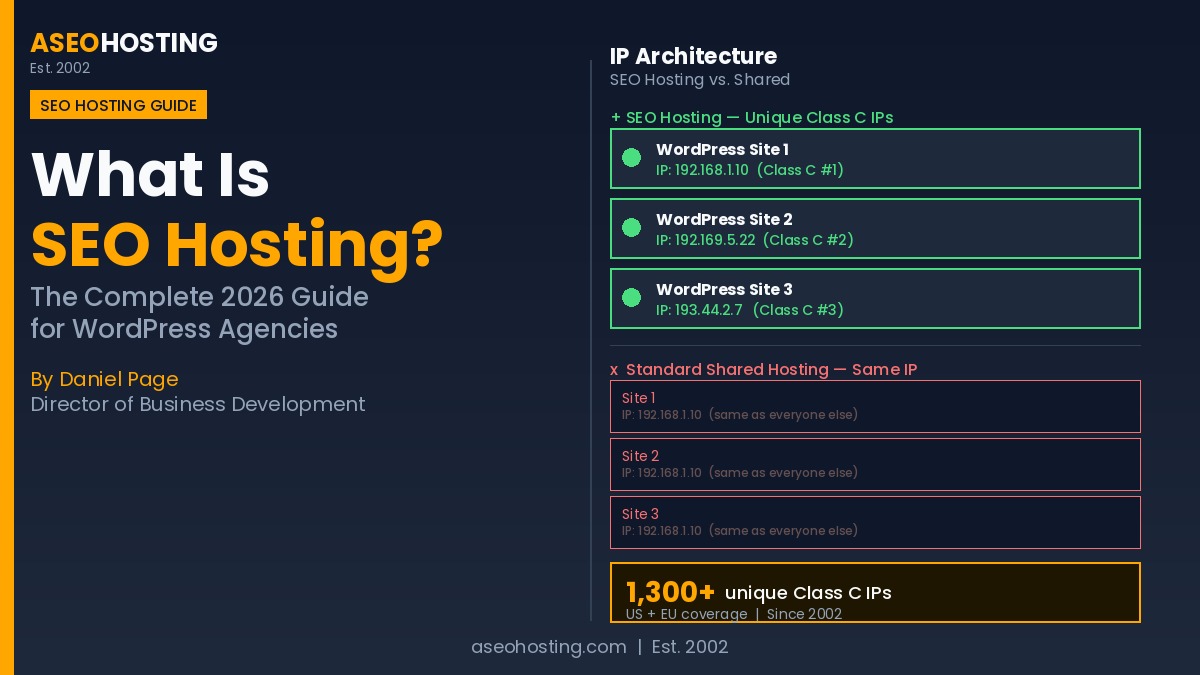
SEO hosting solves a specific problem that standard shared hosting creates for anyone running more than one WordPress site. When all your domains share a single IP address, search engines can detect that shared infrastructure — and that detection changes how links between those sites are evaluated and weighted.
How Standard Hosting Stacks Multiple WordPress Sites on One IP
On a standard shared hosting account, every WordPress site you add resolves to the same IP address. If Site A is at 192.168.1.10 and Site B is also at 192.168.1.10, search engine crawlers see both as living on the same server. That shared-server signal becomes relevant the moment Site A links to Site B: the algorithm knows both ends of the link share the same IP, and in many configurations it applies additional scrutiny to whether that link represents a genuine third-party endorsement or a self-referential arrangement. Furthermore, the value of backlink diversity is rooted in the assumption that links come from genuinely independent infrastructure — a standard shared hosting account undermines that assumption by design. Additionally, even if you never intentionally link between your own sites, the bad-neighbor effect is a separate risk: if another site on that shared IP is flagged for spam or malware, your site inherits a contaminated IP neighborhood whether you know it or not. Notably, WordPress’s own server requirements make no mention of IP configuration — because for a single-site install, it simply does not matter. It only matters the moment your network grows past one domain.
What Changes When Every Site Gets Its Own Dedicated Class C IP
In contrast, SEO hosting distributes each domain across a different Class C IP subnet. A Class C subnet is defined by the first three octets of an IPv4 address: 192.168.1.x is one Class C block, 192.168.2.x is a second, and 193.44.7.x is a third — each appearing to infrastructure-level analysis as independent hosting. When your sites live on different Class C ranges, they register to search engine crawlers as genuinely separate web properties, not branches of a single hosting account. Moreover, private nameservers — unique to each domain rather than pointing to a shared nameserver string — reinforce this separation at the DNS level. ASEOHosting provides private nameserver configuration for every account, a step that most standard WordPress hosts do not include as standard and that most experienced SEO operators know to require before they launch any new domain in a managed network. Specifically, configuring ns1.yourdomain.com and ns2.yourdomain.com for each domain removes the shared-nameserver fingerprint that would otherwise link multiple sites to the same hosting account at the DNS query level — well before any IP address is even checked.

The Three IP Classes That Define SEO Hosting Power
Not all IP diversity is equal. Class C IP variety is the standard entry point for seo hosting, Class B diversity adds another layer of separation, and Class A IP addresses represent the highest-tier differentiation available — the kind enterprise SEO teams and premium authority networks choose when Class C alone is insufficient.
| IP Class | What Makes It Unique | SEO Application | ASEOHosting Availability | Starting Price |
|---|---|---|---|---|
| Class C | Third octet differs (e.g., .1.x vs .2.x vs .3.x) | Standard multi-site IP diversity; removes shared-server signal | 1,300+ unique Class C IPs — US and EU pools | $5.75/IP (10–45 IPs/mo) |
| Class B | Second and third octets differ (e.g., .168.x vs .169.x) | Higher-tier diversity for premium link networks | Available on VPS and Dedicated Server configurations | By configuration |
| Class A | First octet differs (e.g., 64.x.x.x vs 193.x.x.x) | Maximum infrastructure separation — fewest IP blocks exist globally | 5–20 A-Class IP packages available | $7.00–$9.75/IP (5–20 A-Class IPs/mo) |
Class C IPs — The Foundation of Most WordPress Site Networks
Typically, Class C IP diversity is where most seo hosting accounts start — and for the majority of SEO agencies and WordPress multi-site operators, it is where they remain, because 1,300+ unique Class C addresses covers virtually every practical use case. ASEOHosting has maintained this IP pool since 2002, serving over 100,000 WordPress sites across its US and EU infrastructure. That scale means no two client domains need to share a Class C range, and no client’s link profile needs to reveal a shared-server fingerprint. The pricing tiers reward volume: agencies managing 10 to 45 sites pay $5.75 per IP monthly; networks of 50 to 190 sites drop to $4.75 per IP; and networks of 200 or more sites drop further to $4.25 per IP. For most active client rosters, the 50-IP tier at $237.50 per month is the clearest value point — enough diversity for an active agency, at a per-IP rate that beats the entry tier by a full dollar per address. Explore ASEOHosting’s shared SEO hosting plans to compare current IP-count options across both US and EU pools.
Class A IPs — The Premium Choice for High-Stakes Authority Sites
Indeed, Class A IP addresses carry the strongest infrastructure separation signal: their first octets differ, meaning two Class A IPs might look like 64.x.x.x and 193.x.x.x — networks that are geographically and organizationally distinct at the broadest possible level. That degree of separation matters most when operating authority sites in premium niches where every link signal carries outsized weight. ASEOHosting offers Class A IP packages starting at $35 for five A-Class IPs, scaling to $195 for 20 A-Class IPs. For the most competitive authority-building campaigns, pairing a core Class C network with a handful of Class A IPs on your highest-priority properties adds an infrastructure diversity layer that Class C alone cannot provide. In practice, most agencies use Class A IPs selectively — reserved for a handful of top-tier properties — while running the broader site network on Class C addresses.
Who Actually Needs SEO Hosting in 2026 (And Who Does Not)
SEO hosting delivers specific benefits to specific use cases. Agencies managing multiple client WordPress sites, international operators targeting multiple country SERPs, and multi-site WordPress managers building topical authority networks are the primary audiences. A small business running a single WordPress domain does not need it — and would pay significantly more than standard hosting offers without a corresponding benefit. Understanding which side of that line you sit on is the starting point for every seo hosting decision.
SEO Agencies: Client Site Isolation from Bad-Neighbor IP Penalties
For SEO agencies, the primary reason to use WordPress SEO hosting is often not link building at all — it is client isolation. When a client’s WordPress site shares an IP address with another client’s site, any spam, malware, or algorithmic penalty affecting one can contaminate the IP reputation for both. That is an agency liability issue, not merely an SEO inconvenience. Consequently, placing each client domain on its own dedicated Class C IP address removes that shared-fate risk entirely. If a client account is compromised or faces a manual action, the IP signal stays contained to that account. Every other client account on your ASEOHosting plan continues operating from its own clean, isolated IP address — with no exposure to whatever is happening next door. That client protection argument is one most clients understand immediately once it is explained in plain terms.
International WordPress Operators: Geo-Targeted IPs Across US and EU
Similarly, for businesses targeting search results in specific countries, server IP geolocation remains a meaningful signal. Google’s SEO guidance acknowledges that server location contributes to how search engines determine geographic relevance, particularly for country-specific results. A WordPress site hosted on a US IP address competing for German or Swedish SERPs carries a geographic disadvantage that an EU-hosted IP helps neutralize. ASEOHosting operates both US and EU IP pools — offering both US and EU coverage from a single account. That means you can place a German-targeted site on an EU Class C IP while keeping your US properties on US Class C ranges, all managed through one ASEOHosting account. In 2026, combining a country-code TLD with a geographically appropriate IP address continues to be the strongest available geographic relevance signal for international WordPress operators.
Multi-Site WordPress Managers Building Topical Authority Networks
Furthermore, for WordPress operators managing topical content networks — clusters of themed sites that collectively build authority in a vertical — IP diversity reduces the infrastructure footprint that connects those sites at the network level. As we covered in our post on how hosting affects LLM visibility, 2026 search increasingly includes AI-powered systems that evaluate source credibility at the infrastructure level. IP diversity is not the only variable: fast load times, unique content, independent analytics accounts, and genuine topical quality all matter far more than IP configuration alone. That said, IP diversity handles the infrastructure signal cleanly, so that your content and link quality carry the ranking conversation rather than a detectable shared-server pattern undermining it before your content is even evaluated.
SEO Hosting vs. Standard WordPress Hosting: What You Actually Get
The core difference is not performance or support — it is IP architecture. Standard WordPress hosting wins on simplicity and price for single-site owners; seo hosting wins on IP diversity, private nameservers, and client isolation for multi-site operators and agencies. The table below maps the key feature differences side by side.
| Feature | Standard WordPress Hosting | ASEOHosting SEO Hosting |
|---|---|---|
| IP per domain | Shared — hundreds of sites per IP | Dedicated Class C IP, yours alone |
| Class C IP variety | None | 1,300+ unique Class C IPs |
| Private nameservers | Rarely included | Included on every account |
| Client site isolation | Not possible on shared IP | Full per-account IP isolation |
| EU geo-targeted IPs | Not available | US + EU coverage from one account |
| WordPress installation | One-click (varies by host) | One-click via Softaculous |
| Free site migration | Varies by provider | Included from any cPanel host |
| IP Manager Tool | No equivalent | One-click IP reassignment |
| Uptime SLA | Varies (typically 99.9%) | 99.9% guaranteed |
| Starting price | From approx. $3/mo shared IP | From $57.50/mo (10 dedicated IPs) |
In practice, the price difference between standard shared hosting and seo hosting is the price of IP diversity. If your use case does not require IP separation — you run one WordPress site, one client, one domain — standard hosting is the right tool. However, if IP footprint affects your results or your client relationships, seo hosting is the specific infrastructure product built to solve it. There is no general-purpose hosting plan that provides 1,300+ unique Class C IPs by design — that architecture requires a hosting provider whose entire business model is built around it.
How to Choose the Right ASEOHosting Plan for Your WordPress Network
The right ASEOHosting plan depends on how many WordPress sites you manage and where you need them located. The estimator below maps your site count to the appropriate plan tier and monthly price in real time. For US-targeted sites, the standard seo hosting plans apply; for European SERPs, the SEO VPS or EU shared plans extend the same Class C diversity to European datacenter IP ranges.
IP Plan Estimator — Find Your ASEOHosting Tier
Additionally, ASEOHosting’s IP Manager Tool is worth understanding specifically: it lets you reassign any Class C IP to any domain in your account with a single click, without opening a support ticket. No other multiple-IP seo hosting provider offers an equivalent self-service interface. If a site needs to be moved to a fresh Class C IP range, the IP Manager handles the reassignment immediately. For agencies onboarding new clients or offboarding departing ones, that operational flexibility makes IP management genuinely practical rather than a recurring support overhead. See also our overview of how diverse IP hosting supports WordPress and AI search performance for context on why IP configuration matters beyond traditional SEO in 2026.
Frequently Asked Questions: SEO Hosting
Does seo hosting actually work in 2026, or has Google gotten too smart to care about IP diversity?
Specifically, seo hosting continues to work in 2026 for its core purpose: removing the shared-IP infrastructure footprint that can discount link equity between sites you operate. Google has never confirmed IP diversity as a direct ranking signal — the mechanism is protective, not promotional. Shared-IP link relationships are a detectable pattern; unique Class C IPs at the per-domain level remove that pattern. For SEO agencies managing client site isolation and multi-site operators building linked domain networks, that infrastructure-level separation still eliminates the most reliably detectable footprint signal available to crawlers.
SEO hosting vs shared hosting: what’s the actual difference, and which should a WordPress agency use?
Fundamentally, the difference is IP architecture. Standard shared hosting places every domain in your agency’s account on the same IP address — 20 client sites share one IP, making the server relationship visible to search engine crawlers. SEO hosting assigns each domain its own dedicated IP from a unique Class C subnet, so every client site appears as independent infrastructure. For a WordPress agency, that means links between client properties carry independent signal value, and a penalty or malware flag on one client’s IP cannot contaminate another’s reputation on the same account.
Does Google penalize websites that share the same IP address in 2026?
Importantly, Google does not issue algorithmic penalties for shared IP addresses in 2026. Google engineers including John Mueller and Matt Cutts have confirmed that Google evaluates sites individually and understands that shared hosting is common. The real risk is subtler: when multiple sites on the same IP interlink, Google can detect the shared-server relationship and apply additional scrutiny to whether those links represent genuine third-party endorsements. The documented outcome is link equity discounting rather than ranking penalties — but for agencies whose business model depends on link signal integrity between client sites, that distinction matters considerably.
If I manage 30 client WordPress sites on ASEOHosting, does each domain need its own unique Class C IP?
Accordingly, yes — one unique Class C IP per domain is the correct baseline for seo hosting. With 30 client sites, you need at minimum 30 unique Class C addresses, each assigned to a separate domain in your ASEOHosting account. In practice, most agencies at 30 sites choose the 50-IP tier at $237.50 per month, which provides 20 reserve IPs for onboarding new clients and IP reassignment without waiting on new allocations. Moving from 45 to 50 IPs also drops the per-IP rate from $5.75 to $4.75 monthly.
What is a Class C IP address and why does it matter for seo hosting?
Specifically, a Class C IP address is an IPv4 address where the first three octets identify the network block — so 192.168.1.x and 192.168.2.x are two distinct Class C networks, even though their first two octets match. For seo hosting, Class C diversity matters because search engines use IP-level signals to infer infrastructure relationships between domains. Sites sharing the same Class C subnet carry a detectable server fingerprint; sites on different Class C ranges appear as independent infrastructure to search engine crawlers. That is why ASEOHosting maintains over 1,300 unique Class C IP blocks rather than allocating customers from a single datacenter subnet.
SEO hosting vs VPS hosting: which gives better IP diversity for a 30-site WordPress network?
In contrast, seo hosting delivers significantly better IP diversity than a VPS for a 30-site WordPress network. A standard VPS provides one dedicated server with one IP address — or a small range from the same datacenter subnet. A 50-IP ASEOHosting seo hosting plan provides 50 unique Class C addresses drawn from over 1,300 distinct IP blocks, with each client domain appearing to crawlers as hosted on entirely separate infrastructure. VPS hosting solves resource isolation for a single high-traffic site; it does not solve IP-footprint diversity at the per-domain scale a multi-client agency requires.
What is the bad-neighbor IP effect and how does it damage link equity between sites on the same server?
Notably, the bad-neighbor IP effect describes the risk a clean website incurs from co-hosting on an IP address already associated with spam, malware, or manipulative linking. Search engines use IP-level signals to infer infrastructure relationships, and when a shared IP is contaminated by one problematic site, other sites on that address can see their trust signals suppressed and their link equity relationships evaluated with additional scrutiny — even if those sites themselves are entirely clean. The effect is most pronounced for link equity between interlinked sites on the same IP, where the shared-server relationship is already detectable by crawlers regardless of each site’s individual content quality.
If I move a WordPress site to a new Class C IP on ASEOHosting, will Google re-crawl it as if it’s a new domain?
Fortunately, changing a WordPress domain’s IP address via ASEOHosting’s IP Manager does not reset Google’s crawl history or treat the domain as new. Google indexes URLs, not IP addresses, so the domain’s existing indexed pages, rankings, and crawl schedule remain intact after an IP reassignment. What changes is the infrastructure signal: the new Class C IP removes any shared-server associations the previous IP carried with neighboring sites or prior reputation issues. ASEOHosting’s IP Manager processes the reassignment with a single click; DNS propagation typically completes within 24 to 48 hours.
Does ASEOHosting’s private nameserver setup matter for seo hosting, or do only the Class C IPs count?
Indeed, private nameservers matter for seo hosting alongside Class C IP diversity — they address a separate but equally detectable infrastructure signal. When multiple domains share the same nameserver strings such as ns1.hostprovider.com, that shared nameserver fingerprint links those domains together even when their Class C IPs are all unique. ASEOHosting’s private nameserver setup assigns domain-specific nameservers — ns1.yourdomain.com and ns2.yourdomain.com — to each account, removing the shared-nameserver signal at the DNS level. Properly configured seo hosting requires both layers: unique Class C IPs at the hosting level and private nameservers at the DNS level.
Does a dedicated IP address actually improve SEO rankings?
Overall, a dedicated IP address does not directly improve SEO rankings on its own. Google has confirmed through statements from engineers John Mueller and Matt Cutts that it does not use IP type as a ranking signal for standard single-site hosting. The SEO case for dedicated IPs applies specifically to multi-site contexts: when unique Class C IPs are assigned per domain in a linked site network, they remove a detectable infrastructure footprint that can cause link equity to be discounted — not through a ranking bonus, but by eliminating a signal that would otherwise suppress it.